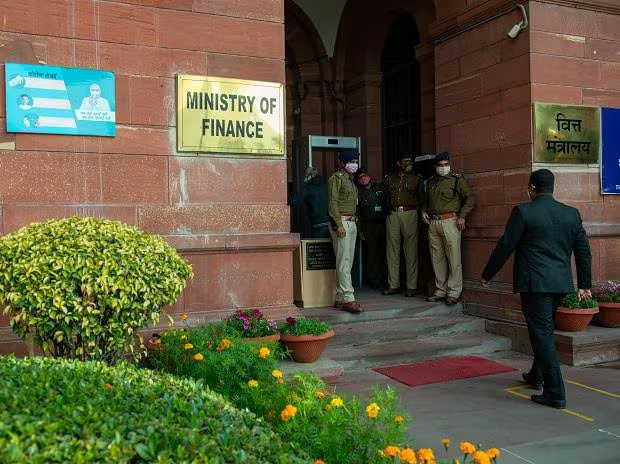
DERC dumps apex court directives, finds convenience in ordering audit

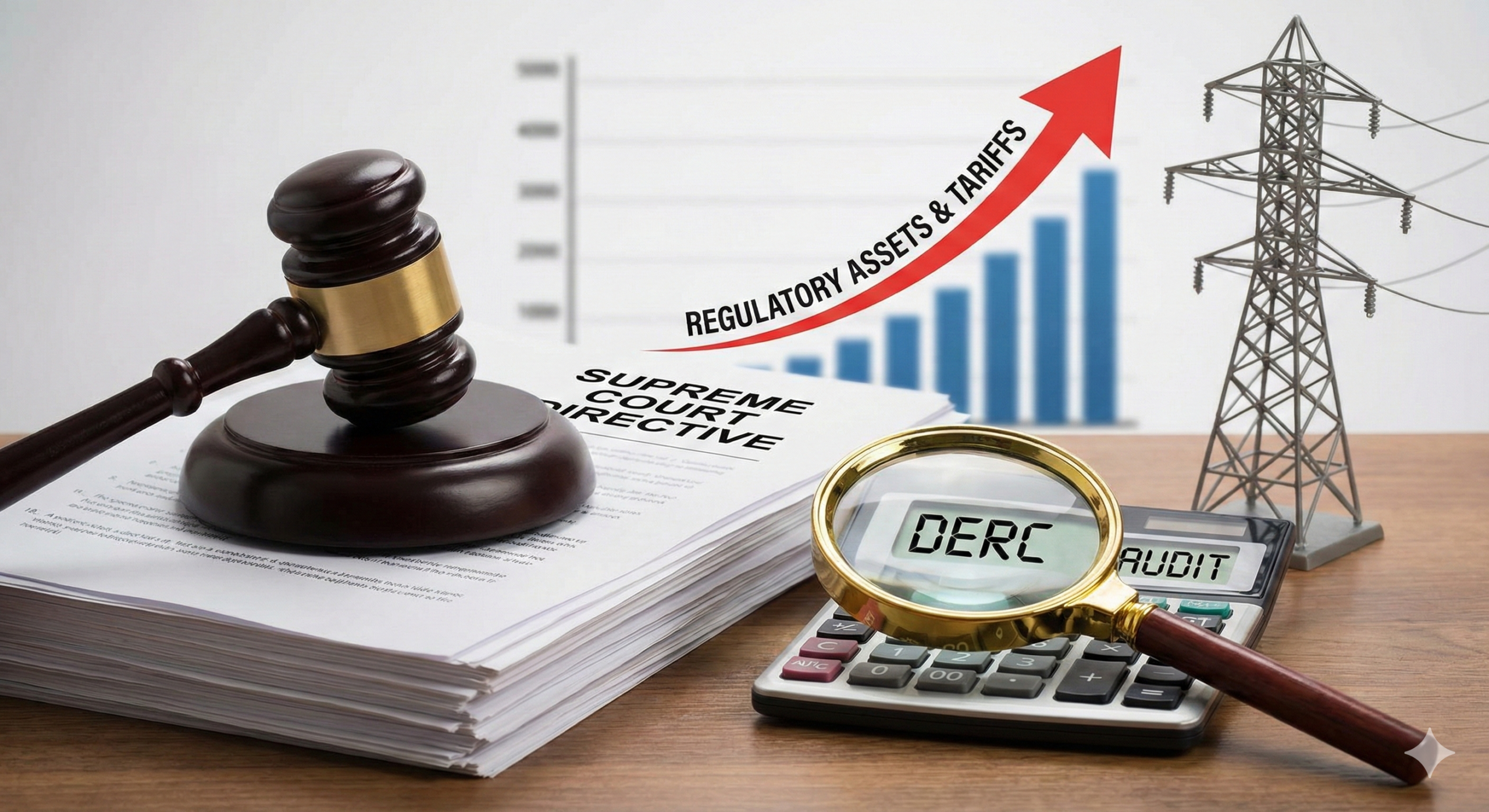
On August 6, 2025 the Supreme Court in its judgement (Annexure-A) had issued general directives to all the State Electricity Regulatory Commissions (SERCs) to liquidate the existing Regulatory Assets (RA) within seven years and had put a cap of 3% of Annual Revenue Requirement (ARR) for any RA that gets created in future, but that too must be liquidated within 3 years. The relevant parts of the directives, as modified vide order dated 28.10.2025, are reproduced below: –
- As a first principle, tariff shall be cost-reflective;
- The revenue gap between the approved ARR and the estimated annual revenue from approved tariff may be in exceptional circumstances;
- The regulatory asset should not exceed a reasonable percentage, which percentage can be arrived on the basis of Rule 23 of the Electricity Rules that prescribes 3% of the ARR as the guiding principle;
- If a regulatory asset is created, it must be liquidated within a period of 3 years, taking Rule 23 as the guiding principle;
- The existing regulatory asset must be liquidated in a maximum of seven years as provided in Rule 23 of the Electricity (Amendment) Rules, 2024
- Regulatory Commissions must provide the trajectory and roadmap for liquidation of the existing regulatory asset, which will include a provision for dealing with carrying costs. Regulatory Commissions must also undertake strict and intensive audit of the circumstances in which the distribution companies have continued without recovery of the regulatory asset;
- Regulatory Commissions shall in general follow the principles governing creation, continuation and liquidation of the regulatory asset, as laid down in paragraph 70, and also abide by the directions of the APTEL summarised in paragraph 69.8;
- The APTEL shall invoke its powers under Section 121 and issue such orders, instructions or directions as it may deem fit to the Regulatory Commissions for performance of their duties with respect to regulatory asset as enunciated by us in this judgment and as per the orders of the APTEL in O.P. No. 1/2011 dated 11.11.2011 and O.P. Nos. 1 and 2/2012 dated 14.11.2013.
- The APTEL shall register a suo moto petition under Section 121 of the Act to monitor implementation of above directions (v) and (vi) till the conclusion of the period mentioned therein.
Regulatory assets of Discoms represent the accumulated, unrecovered revenue gap between the Average Cost of Supply (ACS) and the ARR, essentially functioning as deferred debts owed to distribution companies. These arise when regulators allow tariff hikes to be postponed, primarily due to political reasons, creating a financial deficit.
Pursuant to the order of the Supreme Court, the Appellate Tribunal for Electricity (APTEL) was required to oversee the implementation of the said order by the SERCs.
However, even several months after the Supreme Court’s direction, the SERCs — who are required to recover more than ₹3 lakh crore by way of tariff hikes — have failed to comply with the order in its true letter and spirit.
Recently, Delhi Electricity Regulatory Commission (DERC), instead of adhering to the Supreme Court’s mandate, has involved the Comptroller and Auditor General (CAG) to conduct a wide-ranging audit of the discoms.
The Supreme Court’s order is limited and specific in scope: it requires the SERCs themselves to ascertain the reasons for the massive accumulation of Regulatory Assets, which impose a significant carrying-cost burden on end consumers, and to determine the measures necessary to ensure that such accumulation never recurs anywhere in India.
It now remains to be seen how APTEL responds — specifically, whether it will rein in the SERCs’ actions that risk imposing an even heavier burden on India’s poor consumers in the form of severe and sudden tariff shocks.
Recently, Delhi Electricity Regulatory Commission (DERC), instead of adhering to the Supreme Court’s mandate, has involved the Comptroller and Auditor General (CAG) to conduct a wide-ranging audit of the discoms (Annexure-B). The move goes against the 2015 judgement of the Delhi High Court.
On 08.07.2010 DERC had requested the Delhi government to request the CAG for an audit of the accounts of all the three Discoms operating in Delhi. On 7.01.2014, asked the CAG to conduct an audit of the accounts of the Discoms from the date of their inception i.e. 1.07.2002 till date. The discoms challenged this move before Delhi High Court. The division bench of the Delhi High Court did not find CAG audit to be appropriate, and on 30.10.2015 (Annexure-C) quashed the direction for audit of Discoms issued by Delhi government under Section 20(1) of the CAG Act.
The Supreme Court’s 2025 order is also limited and specific in scope: it requires the SERCs themselves to ascertain the reasons for the massive accumulation of Regulatory Assets, which impose a significant carrying-cost burden on end consumers, and to determine the measures necessary to ensure that such accumulation never recurs anywhere in India.
It now remains to be seen how APTEL responds — specifically, whether it will rein in the SERCs’ actions that risk imposing an even heavier burden on India’s poor consumers in the form of severe and sudden tariff shocks.
Annexure-A
Annexure-B
Annexure-C
You may also like