Deliver Reserved Judgments

The three-month rule the Supreme Court wrote for everyone but itself
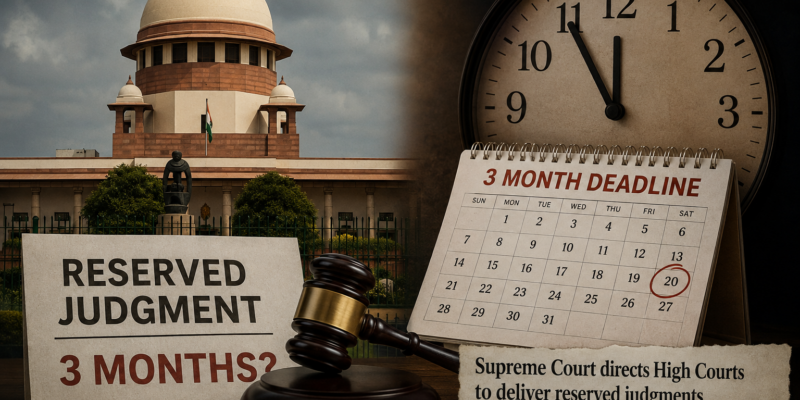
On 29 May 2026 the Supreme Court told every High Court in the country to deliver reserved judgments within three months. It framed the directions under Article 142, called them binding, and grounded them in Article 21. It wrote no equivalent rule for itself, and gave no reason for this omission.
What the order says
Pila Pahan @ Peela Pahan v. State of Jharkhand, W.P.(Crl.) No. 169 of 2025, decided 29 May 2026 by Chief Justice of India Surya Kant and Justice Joymalya Bagchi. It began as four convicts’ complaint about criminal appeals reserved by the Jharkhand High Court in 2022 and still undecided; the Court enlarged it and framed pan-India guidelines. Reasoned judgment within three months of reservation. Bail orders same day, next day if reserved. Reasons within 7–15 days where only the operative part is pronounced. Automated monthly lists to the Chief Justice; after three months the Registrar General puts the file before him, and the matter can be reassigned to a fresh bench. Litigants may apply for release of the judgment after three months, and for withdrawal to another bench beyond the fourth.
Built on Anil Rai v. State of Bihar, (2001) 7 SCC 318 and Ratilal Jhaverbhai Parmar v. State of Gujarat, 2024 INSC 801.
The gap
No statute fixes a period for the Supreme Court. The Supreme Court Rules, 2013 contain nothing. Order XX Rule 1 CPC — 30 days, extendable to 60 — governs civil courts, not the Court’s own appellate procedure, regulated under Article 145 by its own Rules. Every mechanism in Pila Pahan is High-Court-specific: the Registrar General of the High Court, the Chief Justice of the High Court, the High Court website. Internal case-management practice does contemplate re-listing long-reserved matters, but it is unpublished, administrative and unenforceable by a litigant. There is no public reserved-judgment tracker.
The live illustration
The Yes Bank AT-1 bonds appeals. Judgment was reserved on 26 February 2026, that order was recalled on 19 May, and judgment was reserved afresh on 20 May 2026. Three months expired on 20 August. Presiding: Dipankar Datta, J., who authored Ratilal, one of the two authorities the 29 May directions rest on, and who there set aside a Gujarat High Court order for delay in supplying reasons.
Points to get right
- Three months, not 90 days. The order says “three months from the date of reserving judgment,” and the formulation is “shall endeavour,” reinforced by consequences — not a jurisdictional bar.
- The withdrawal trigger is ambiguous in the reports. The body of the order says “3+1 months”; the headnote as circulated says 3.5 months.
- The Yes Bank write-down is Rs 8,415 crore, not Rs 8,400 crore. The impugned act was the Administrator’s communication of 14 March 2020, a day after the Final Reconstruction Scheme was notified on 13 March — not, as often written, “the RBI’s decision.” That distinction is the ratio: the Bombay High Court held the Scheme carried no write-down provision and the bank stood reconstituted before the Administrator acted.
- Bombay High Court: 20 January 2023, Gangapurwala, ACJ and S.M. Modak, J. — Axis Trustee Services Ltd. v. Union of India, 2023 SCC OnLine Bom 180. Lead matter W.P. No. 785 of 2021, not the March 2020 petition.
- The 3 March 2023 stay bench was D.Y. Chandrachud, CJI, with P.S. Narasimha and J.B. Pardiwala, JJ. Three Chief Justices have held office since; “the then CJI” is not enough.
- Appeal numbers carry 2025, filings are from 2023. The appeals were filed in February–April 2023 and numbered only on admission on 19 February 2025. Written without that explanation it reads as an error.
The fair caveat
The Court’s record is better than the anecdotes. Of the 60 matters in which it reserved judgment in July 2025, the median disposal time was 27 days and the mean 47; 39 were delivered within 60 days, seven were still pending in late April 2026, one took 226. The honest framing is an accountability gap, not a performance failure. There is also a case for the distinction: every remedy in Pila Pahan presupposes a supervisory authority who can withdraw a matter from a bench, and no such authority sits above the Supreme Court. Against that stands the obvious point — the reasoning is Article 21, the prejudice to a waiting litigant is identical, and there is nowhere further to appeal. Suresh Kumar Koushal was reserved for close to 21 months.
You may also like